
Then you zoom down to the scale of atoms and particles, and all of that logic quietly falls apart. Quantum physics doesn't just add new rules to the world we know, it reveals that the rules we thought were universal only apply to the "big" version of reality. Down at the smallest scales, the universe behaves in ways that genuinely don't make intuitive sense, even to the physicists who study it for a living.
Here's a look at some of the strangest, most mind-bending ways quantum physics breaks common sense, and why scientists take these ideas seriously despite how bizarre they sound.
## Particles Can Be in Multiple States at Once
In everyday life, a coin is either heads or tails, even before you look at it, it already has a definite state, you just don't know it yet. In quantum physics, particles genuinely don't work this way.
Before being measured, a quantum particle can exist in a "superposition," essentially a combination of multiple possible states at the same time. It's not that the particle secretly has one true state we simply don't know yet, it's that the particle behaves as though it holds all the possibilities simultaneously, right up until the moment it's measured.
This isn't just a philosophical quirk. It's been demonstrated repeatedly in experiments, and it's the foundational principle behind quantum computers, which use this multi-state behavior to perform certain calculations far more efficiently than traditional computers ever could.
## Observing Something Can Change What It Does
Here's where things get even stranger. In quantum mechanics, the act of measuring or observing a particle can actually affect its behavior, not because the measuring equipment physically disturbs it (though that can happen too), but because the act of measurement appears to force the particle out of its superposition and into one definite state.
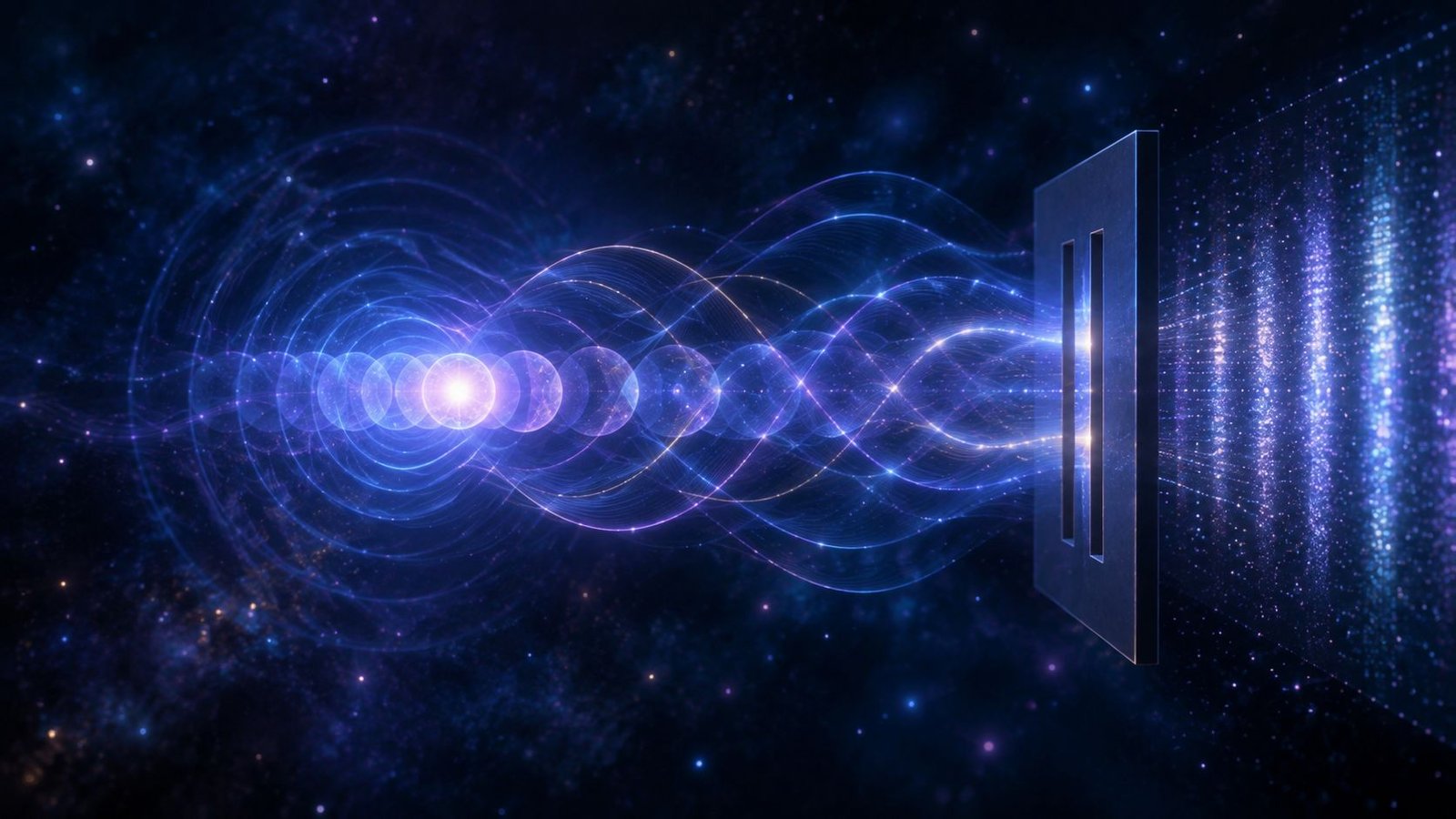
The most famous illustration of this is the double-slit experiment. When individual particles like electrons are fired at a barrier with two slits, and no one is watching which slit they pass through, they behave like waves, creating an interference pattern on the other side, as if each particle passed through both slits simultaneously and interfered with itself. But the moment scientists set up a way to detect which slit each particle actually goes through, that wave-like interference pattern disappears entirely, and the particles start behaving like ordinary individual particles instead.
Simply looking, in other words, changes the outcome.
## Light and Matter Are Both Waves and Particles
Common sense tells us something is either a wave (like sound or ripples in water) or a particle (like a tiny ball). Quantum physics says light, and even matter itself, can behave as both, depending on how you look at it.
This is called wave-particle duality. Light can behave like a wave, spreading out and interfering with itself, or like a stream of individual particles called photons, depending on the experiment being run. The same has been shown to be true, at smaller scales, for actual particles of matter like electrons.
It's not that scientists haven't figured out which one it "really" is. The honest answer is that at the quantum level, the wave-versus-particle distinction we rely on in everyday life simply doesn't cleanly apply.
## Entangled Particles Seem to Communicate Instantly
Perhaps the strangest idea in quantum physics is entanglement. When two particles become "entangled," measuring the state of one instantly correlates with the state of the other, even if they're separated by enormous distances, in theory, even across the entire universe.
Albert Einstein famously found this deeply uncomfortable, referring to it as "spooky action at a distance," because it seemed to violate the basic rule that nothing can travel or influence anything else faster than the speed of light. Decades of experiments have since confirmed that entanglement is real, though the effect doesn't actually allow information to be sent faster than light, since you can't control what result you'll get on your end.
What entanglement really tells us is that, at the quantum level, particles that interacted in the past can remain connected in a way that has no clear equivalent in ordinary, everyday experience.
## The Universe Might Not Be Fully Deterministic
Classical physics assumes that if you know everything about a system right now, you can, in principle, predict exactly what will happen next. Quantum mechanics challenges this in a genuinely unsettling way.
According to the standard interpretation of quantum mechanics, some events at the quantum level are fundamentally probabilistic, not just unpredictable because we lack enough information, but actually random at their core. A radioactive atom, for example, decays at a completely random moment, not because of any hidden variable we haven't discovered yet, but because that randomness appears to be a genuine feature of reality itself.
This directly challenges the intuitive assumption that everything in the universe has a definite, predictable cause leading to a definite, predictable effect.
## You Can't Know Everything About a Particle at Once
The Heisenberg uncertainty principle states that certain pairs of properties, like a particle's exact position and its exact momentum, can't both be precisely known at the same time. This isn't a limitation of our measuring instruments; it's a fundamental property of nature itself.
The more precisely you pin down where a particle is, the less precisely you can know how fast it's moving, and vice versa. In everyday life, we assume that with a good enough tool, we could measure absolutely anything as precisely as we want. Quantum mechanics says that assumption simply doesn't hold at the smallest scales, no matter how advanced the technology gets.
## Why This Matters Beyond Just Being Strange
It would be easy to write off quantum weirdness as an interesting curiosity that doesn't affect everyday life, but that's not quite accurate. Quantum mechanics underlies the technology behind semiconductors, lasers, MRI machines, and the rapidly developing field of quantum computing. The "common sense-breaking" behavior of particles isn't just a philosophical puzzle, it's a foundational part of how a huge amount of modern technology actually works.
## Final Thought
Quantum physics doesn't break common sense to be difficult or contrarian, it reveals that our intuitions were built entirely from experiences at a much larger scale than atoms and particles actually operate on. The universe, it turns out, plays by different rules depending on how closely you look, and some of those rules genuinely defy the logic we rely on every single day. That gap between intuition and reality is exactly what makes quantum physics one of the most fascinating, and humbling, areas of science we've ever discovered.
Frequently Asked Questions
How do I comment on a Articlesblog article?
Scroll to the Comments section at the bottom of any article, enter your name, email, and message, and click Post Comment. No account is needed, but every comment is moderated — it appears publicly only after the editorial team approves it. See the Privacy Policy for how details are handled.
Why hasn't my comment appeared?
Comments are held for review by default. If yours has not appeared, it is still pending or was rejected during moderation; approved comments appear on the article automatically. If it has been waiting more than a day or two, send a note through the contact page.
How do I share a Articlesblog article?
Every article has a share bar with buttons for Facebook, X, Pinterest, LinkedIn, WhatsApp, Threads, Instagram, TikTok, and YouTube, plus a Copy Link button. Clicking a button opens that network's share window with the article link and title already filled in.
How does Articlesblog pick related articles?
The Related Articles sidebar and the More to Read section show up to four other published articles from the same category, ranked by view count, with popular articles from elsewhere on the site added when the category is new. Tags under each article link to related searches.
Does an article show when it was last updated?
Article pages show the author, publish date, reading time, and view count. A separate last-updated date is not displayed at present, so treat the publish date as the article's currency. Ask the team about a specific article's revision history via the contact page.




Comments (0)
Be the first to comment!
Leave a Comment