
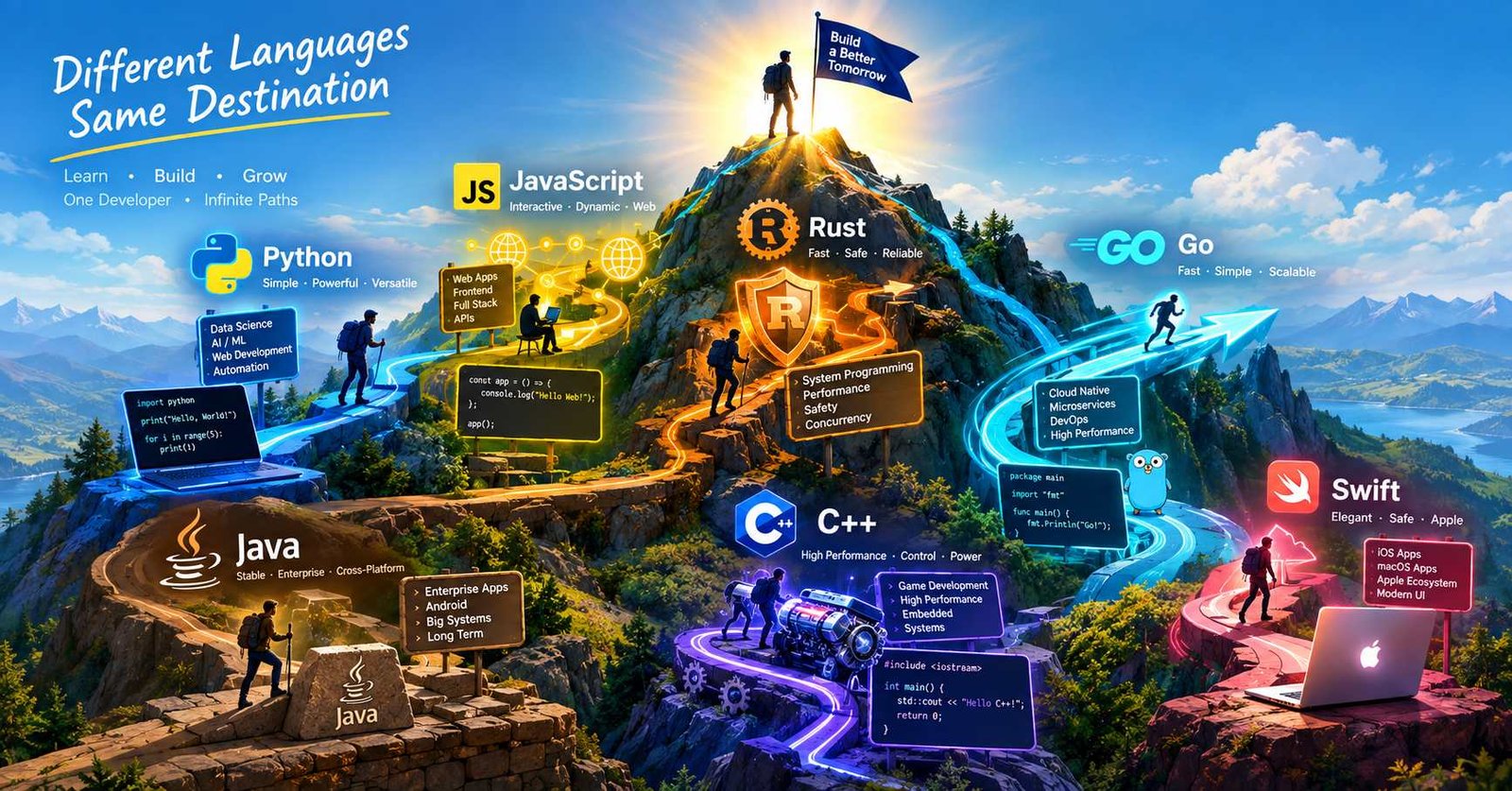
So you want to learn to code.
Maybe you're looking to switch careers. Maybe you want to build that app idea that's been bouncing around in your head. Maybe you just love the idea of creating something from scratch.
The first question everyone asks: "What programming language should I learn?"
And honestly? The answer is more nuanced than "learn Python." Don't get me wrong—Python is great. But what's "best" depends entirely on *what you want to build* and *where you want to work*.
Let me help you figure out which language actually fits your goals, not just what's trendy.
## The Reality Check: You Don't Need to Learn "The Best" Language
Here's something nobody tells beginners: **the language matters less than you think**.
Learning your first programming language is like learning your first instrument. Whether you start with guitar, piano, or violin, you're learning the same fundamental concepts: rhythm, timing, theory. Once you master one, picking up another is way easier.
The same is true in programming. Once you understand loops, functions, conditionals, and data structures in one language, you can learn another in a fraction of the time.
So stop worrying about picking "the wrong" language. Pick one, commit to it for 3-6 months, and you'll figure out if you like it. That experience transfers everywhere.
That said, let me walk you through the languages that matter most in 2026 and what they're actually good for.
## Python: The Swiss Army Knife of Programming
**Skill Level:** Beginner-friendly
**Job Market:** Extremely hot
**Salary Potential:** $100k-$150k+
**Why It's Popular:** Reads almost like English, powerful libraries, used everywhere
If I had to recommend one language for a complete beginner in 2026, it'd still be Python.
Why? Because Python is genuinely useful for almost everything:
**Data Science & Machine Learning**
Python dominates here. Libraries like NumPy, Pandas, and TensorFlow make analyzing data and building AI models accessible to everyone, not just PhDs.
Frameworks like Django and Flask power millions of websites and APIs.
Need to automate a repetitive task? Python is your friend. IT professionals use Python constantly to save themselves hours of manual work.
**Game Development**
Yes, you can build games with Python (using Pygame).
ChatGPT? Built with Python. Most modern AI projects use Python.
The catch? Python isn't the fastest language. If you need blazing-fast performance, Python might not be your first choice. But for learning, for prototyping, for most real-world applications, Python is incredible.
**Should you learn Python in 2026?** If you're unsure what you want to build, yes. You can't go wrong.
## JavaScript/TypeScript: The Language of the Web
**Skill Level:** Beginner to Intermediate-friendly
**Job Market:** Massive and consistently growing
**Salary Potential:** $90k-$150k+
**Why It's Popular:** Runs in every browser, enormous ecosystem, full-stack capability
Here's the thing about JavaScript: it literally powers the web. Every interactive website you use runs JavaScript.
But JavaScript has evolved. TypeScript (a "superset" of JavaScript that adds structure and type safety) is now the professional standard. Many companies are transitioning to TypeScript.
**Where JavaScript/TypeScript Shines:**
React, Vue, Angular—all use JavaScript/TypeScript. If you want to build beautiful, interactive web experiences, you need JavaScript.
With Node.js, you can use JavaScript on the backend too. One language for front and back? Efficient and increasingly popular.
React Native lets you build mobile apps with JavaScript.
**Real-Time Applications**
Websockets and frameworks like Socket.io make real-time features (chat, notifications, live updates) natural in JavaScript.
**The Challenge:** JavaScript has a steeper learning curve than Python initially, but once it clicks, you can build almost anything for the web.
**Should you learn JavaScript in 2026?** Absolutely, if web development excites you. The job market is huge, and remote positions are plentiful.
## Rust: The Future of Systems Programming
**Skill Level:** Intermediate to Advanced
**Job Market:** Growing rapidly
**Salary Potential:** $120k-$180k+
**Why It's Popular:** Speed, memory safety, no garbage collection, prevents entire classes of bugs
Rust is the language people don't expect to fall in love with but do.
It's hard. I'll be honest. Rust has a strict compiler that rejects code that's unsafe. Your first week, you'll fight the compiler constantly. But here's why that matters: Rust prevents entire categories of bugs that plague other languages.
**Where Rust Excels:**
**Systems Programming**
Building operating systems, embedded systems, or performance-critical software? Rust is perfect.
**Blockchain**
Major blockchain projects (Polkadot, Solana) use Rust because it's secure and efficient.
**WebAssembly**
Compile Rust to WebAssembly and run it in browsers at near-native speeds.
**Cloud Infrastructure**
Companies like Amazon, Google, and Cloudflare are increasingly using Rust internally.
**Game Development**
Bevy is an emerging game engine built in Rust.
**Why Learn It:** Rust jobs are opening faster than developers are graduating. It's still niche, but it's growing. If you're willing to learn something harder, Rust pays off.
**Should you learn Rust in 2026?** Only if you like a challenge or are interested in systems programming or blockchain. Not a beginner-friendly starting point, but incredible career potential.
## Go (Golang): The Practical Backend Language
**Skill Level:** Beginner-friendly
**Job Market:** Growing in cloud/DevOps
**Salary Potential:** $110k-$160k+
**Why It's Popular:** Simple, fast, great for backend services, excellent for cloud infrastructure
Go was designed by Google to be simple and practical. And it shows.
Go is like the "sweet spot" language. It's easier to learn than Rust but more efficient than Python. It compiles to a single binary (no dependencies to install on servers). It has built-in support for concurrency (handling multiple tasks simultaneously), which is crucial for modern backends.
**Where Go Excels:**
**Microservices & Cloud**
Docker, Kubernetes—many cloud tools are written in Go. It's the de facto language for cloud infrastructure.
**DevOps & Tooling**
If you want to build command-line tools that developers love, Go is your language.
**Backend Services**
Companies like Netflix, Uber, and Dropbox use Go for critical backend services.
**API Servers**
Building fast, reliable REST APIs? Go is phenomenal.
**The Reality:** Go isn't trying to do everything. It does backend and infrastructure really well, and that's it. But what it does, it does exceptionally well.
**Should you learn Go in 2026?** If you're interested in backend development or cloud infrastructure, absolutely. It's easier than Rust, has amazing job prospects, and genuinely enjoyable to work with.
## Java: Still King in Enterprise
**Skill Level:** Intermediate
**Job Market:** Massive (mostly enterprise jobs)
**Salary Potential:** $100k-$160k+
**Why It's Popular:** Runs everywhere, massive ecosystem, strong job market, stability
Java isn't sexy. Nobody gets excited about Java. But Java keeps the lights on.
Huge corporations—banks, insurance companies, governments—run critical systems on Java. That means constant job demand and solid paychecks.
**Where Java Dominates:**
**Enterprise Applications**
Big corporations use Java because it's stable, well-documented, and has been battle-tested for 25+ years.
Officially, Android now uses Kotlin, but Java skills transfer. Many Android apps are still partially Java.
**Large-Scale Systems**
When you need to manage millions of transactions or complex distributed systems, Java has the tools.
**The Catch:** Java is verbose. You write more code to do the same things compared to Python. Learning it takes longer, and the initial motivation is harder to find.
**Should you learn Java in 2026?** If you want enterprise job security and stability, yes. If you want rapid prototyping and quick wins, try Python or Go first.
## C++: For Performance Obsessives
**Skill Level:** Advanced
**Job Market:** Specialized (good for those who master it)
**Salary Potential:** $120k-$180k+
**Why It's Popular:** Blazing speed, used in critical systems, game development, finance
C++ is powerful. Terrifyingly powerful. And also terrifying to learn.
Major games (Unreal Engine), financial trading systems, operating systems, and graphics engines use C++. When performance is life or death, C++ is your language.
But you'll spend your first 6 months fighting with pointers, memory management, and cryptic compiler errors.
**Should you learn C++ in 2026?** Only if you want to build games (Unreal Engine) or need extreme performance. Not a beginner language. Consider it after mastering basics in Python or JavaScript.
## Kotlin: The Modern Java Alternative
**Skill Level:** Beginner to Intermediate
**Job Market:** Growing in Android development
**Salary Potential:** $95k-$140k+
**Why It's Popular:** Cleaner than Java, interoperates with Java, official Android language
Kotlin is what happens when you take Java, remove all the unnecessary verbosity, and make it actually pleasant to use.
Google announced Kotlin as the preferred language for Android development, which gives it official backing.
If you already know Java, learning Kotlin takes days. If you're new to programming, Kotlin is actually friendlier than Java.
**Should you learn Kotlin in 2026?** If you want to build Android apps, yes. Otherwise, it's a bonus skill on top of Java knowledge.
## Swift: Apple's Baby
**Skill Level:** Beginner to Intermediate-friendly
**Job Market:** Good for iOS development
**Salary Potential:** $100k-$150k+
**Why It's Popular:** Official iOS/macOS language, safe, modern syntax
Swift is Apple's language for iOS, macOS, watchOS, and tvOS development.
If you want to build iPhone apps, Swift is non-negotiable.
**Should you learn Swift in 2026?** Only if you want to develop for Apple products. The job market is solid but more specialized than web development.
## SQL: The Language Everyone Needs
**Skill Level:** Beginner-friendly
**Not Really a General-Purpose Language, But...**
I'd be remiss not to mention SQL. Every programmer, regardless of their main language, needs to know SQL.
SQL is how you talk to databases. And virtually every application touches a database. Learning SQL is non-optional if you want a programming job.
The good news? SQL is simpler than most programming languages. You can learn functional SQL in a weekend.
## The Honest Rankings for 2026
**For Complete Beginners:**
1. Python (easiest, most useful)
2. JavaScript (powerful, immediate results in browser)
3. Go (simple, practical)
**For Career Growth:**
1. Python (data science, AI boom)
2. JavaScript/TypeScript (web is everywhere)
3. Rust (premium salaries, fast-growing)
**For Job Security:**
1. Java (enterprise stability)
2. Python (broad applications)
3. Go (cloud infrastructure boom)
**For Building Things Quickly:**
1. Python (scripts, automation, prototypes)
2. JavaScript (web apps)
3. Go (backend services)
**For High Salary Potential:**
1. Rust ($120k-$180k)
2. C++ ($120k-$180k)
3. Go ($110k-$160k)
## What Should YOU Learn?
Here's my honest advice:
**If you're unsure:** Start with Python. It's forgiving, powerful, and you'll see results quickly.
**If you want to build websites:** Learn JavaScript/TypeScript.
**If you want backend services:** Learn Go.
**If you want to learn something cutting-edge:** Learn Rust.
**If you want job security in enterprise:** Learn Java.
**If you want to build games:** Learn C++ (for Unreal Engine) or C# (for Unity).
**If you want mobile apps:** Learn Swift (iOS) or Kotlin (Android).
Most importantly: **pick one, commit for 3 months, and stick with it.** The language matters less than building real projects and developing true skill.
## The Real Secret
Here's what nobody tells beginners: the language is about 20% of your success. The other 80% is:
- **Problem-solving ability** (practice on LeetCode, HackerRank)
- **Building real projects** (not just tutorials)
- **Understanding data structures and algorithms** (applies to every language)
- **Consistency** (coding a little every day beats cramming)
- **Reading other people's code** (learn from open source)
You can learn the "wrong" language and still become an amazing programmer. You can learn the "right" language and plateau because you're not building anything.
Focus on fundamentals. The language is just the tool.
## Getting Started in 2026
1. **Pick a language** based on your goals
2. **Find a free resource** (freeCodeCamp, Codecademy, Udemy courses)
3. **Build something small** (a calculator, a to-do app, a web scraper)
4. **Join a community** (Reddit's r/learnprogramming, Discord servers)
5. **Build something bigger** (a real project that solves a real problem)
6. **Contribute to open source** (solidify your skills, build resume)
7. **Repeat** (learn a second language with confidence)
## The Bottom Line
2026 is an amazing time to learn programming. The languages keep getting better, the communities are supportive, and the job market is strong.
Your first language doesn't define your career. Your first project does.
So stop overthinking, pick a language, and start building something. You've got this.
https://www.hostinger.com/pk?REFERRALCODE=khanit
Promocodes : KhanIT
https://cp.gthost.com/en/join/803585de87b3603d0c871cab8bf73978
Frequently Asked Questions
How do I comment on a Articlesblog article?
Scroll to the Comments section at the bottom of any article, enter your name, email, and message, and click Post Comment. No account is needed, but every comment is moderated — it appears publicly only after the editorial team approves it. See the Privacy Policy for how details are handled.
Why hasn't my comment appeared?
Comments are held for review by default. If yours has not appeared, it is still pending or was rejected during moderation; approved comments appear on the article automatically. If it has been waiting more than a day or two, send a note through the contact page.
How do I share a Articlesblog article?
Every article has a share bar with buttons for Facebook, X, Pinterest, LinkedIn, WhatsApp, Threads, Instagram, TikTok, and YouTube, plus a Copy Link button. Clicking a button opens that network's share window with the article link and title already filled in.
How does Articlesblog pick related articles?
The Related Articles sidebar and the More to Read section show up to four other published articles from the same category, ranked by view count, with popular articles from elsewhere on the site added when the category is new. Tags under each article link to related searches.
Does an article show when it was last updated?
Article pages show the author, publish date, reading time, and view count. A separate last-updated date is not displayed at present, so treat the publish date as the article's currency. Ask the team about a specific article's revision history via the contact page.



Comments (0)
Be the first to comment!
Leave a Comment