
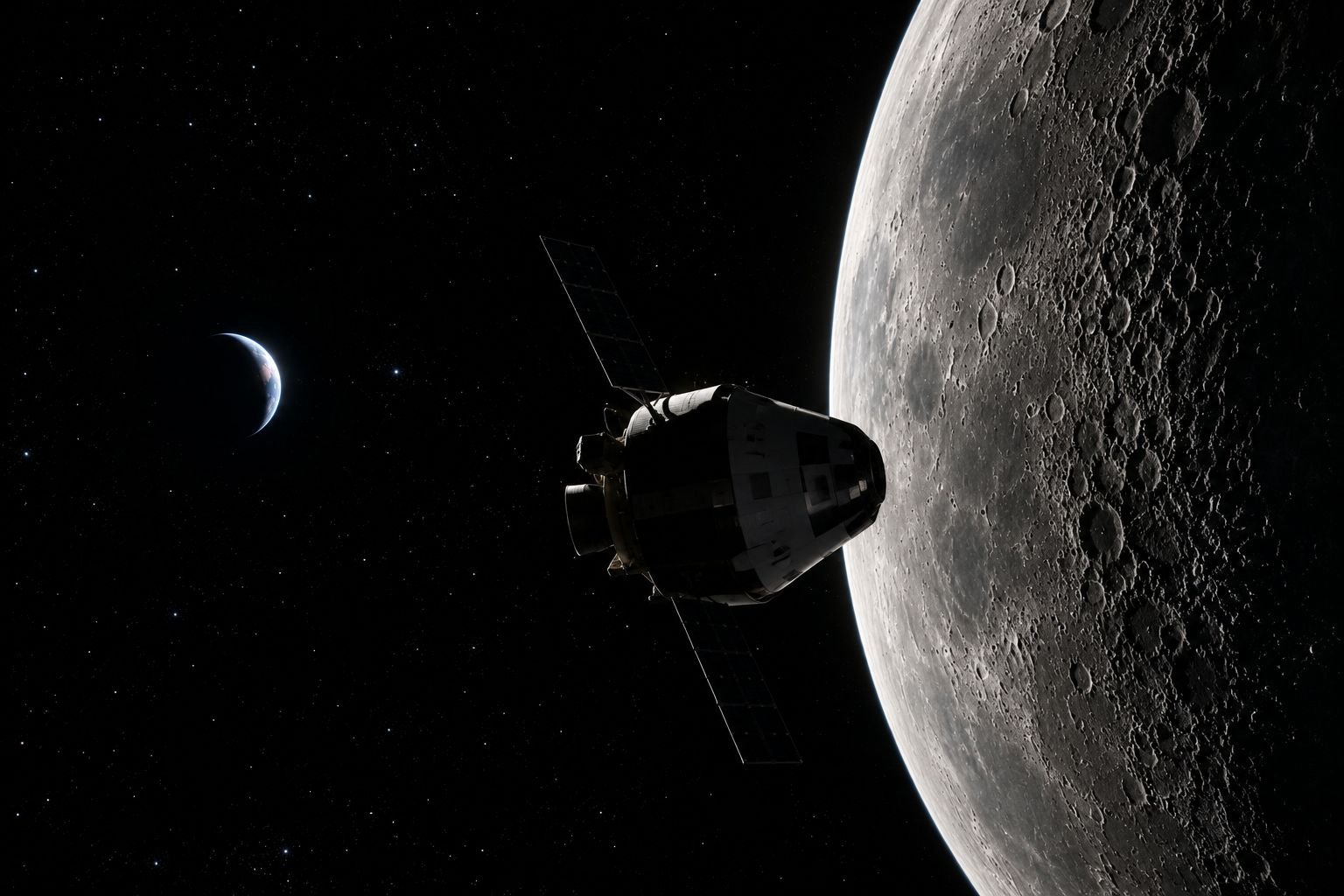
Here's a real look at how far humans have gone, how that record has changed recently, and just how tiny that distance is compared to the universe we're trying to understand.
## Most Astronauts Never Leave Low Earth Orbit
The vast majority of people who have ever gone to space, including everyone who has ever lived on the International Space Station, have stayed in what's called low Earth orbit. The ISS orbits at roughly 250 miles above Earth's surface, which sounds impressive until you realize that's roughly the distance of a short domestic flight, just straight up instead of sideways.
Most commercial and government astronauts, including those on the space shuttle program, various space station missions, and newer commercial spaceflights, have operated within this same relatively narrow band above Earth.
## The Apollo Missions Went Much Further
The Apollo program in the 1960s and '70s remains the only time in history humans have traveled beyond low Earth orbit in significant numbers, heading all the way to the Moon, roughly 239,000 miles away on average.
For decades, the record for farthest distance any human had ever traveled from Earth belonged to the crew of Apollo 13. Ironically, that record wasn't set during a successful landing attempt. Apollo 13's lunar landing was aborted after an onboard explosion, and the crew used the Moon's gravity to slingshot themselves back toward Earth for a safe return, a maneuver that took them slightly farther from Earth than any lunar landing mission had gone. That flight, in April 1970, put the crew about 248,655 miles from Earth, a record that stood for more than fifty years.
## Artemis II Just Broke That Fifty-Year Record
In April 2026, that decades-old record finally fell. NASA's Artemis II mission, carrying astronauts Reid Wiseman, Victor Glover, and Christina Koch, along with Canadian Space Agency astronaut Jeremy Hansen, completed a crewed flyby around the far side of the Moon. At its farthest point, the crew reached roughly 252,756 miles from Earth, surpassing the Apollo 13 record by a little over 4,000 miles.
This wasn't a landing mission. Artemis II was designed as a test flight to confirm that the Orion spacecraft and its life support systems could safely carry a crew around the Moon and back, an essential step before NASA attempts an actual crewed lunar landing with the Artemis III mission. Because of the specific trajectory the mission followed, the crew also became the first humans to see the Moon's far side with their own eyes, rather than only through photographs, something not even the original Apollo astronauts experienced from that vantage point.
## So Just How Far Is That, Really?
To put these numbers in perspective:
- The ISS orbits about 250 miles from Earth.
- The Moon sits roughly 239,000 miles away on average.
- The farthest a human has ever traveled, as of the Artemis II mission, is about 252,756 miles.
- Mars, by comparison, is anywhere from about 34 million to over 250 million miles away, depending on where both planets are in their orbits at the time.
In other words, even our record-breaking human spaceflight distance is still only a tiny fraction of the distance to the nearest other planet, let alone anywhere further out in the solar system.
## Machines Have Gone Unbelievably Farther
While humans have stayed relatively close to home, our unmanned spacecraft have gone almost unimaginably far. NASA's Voyager 1 probe, launched in 1977, has traveled more than 15 billion miles from Earth and has already left the heliosphere, the bubble of particles and magnetic fields generated by our Sun, entering what's considered interstellar space.
That distance dwarfs anything a human being has personally experienced, and it highlights just how much easier it currently is to send instruments into deep space than to send, and safely return, actual people.
## Why the Distance Gap Is So Big
The reason humans haven't gone nearly as far as our machines comes down to a mix of very real, practical challenges:
- **Life support.** Machines don't need oxygen, food, water, or protection from radiation over years-long journeys.
- **Radiation exposure.** Beyond Earth's protective magnetic field, cosmic radiation becomes a serious health risk the longer and farther a mission travels.
- **Weight and fuel.** Carrying the systems needed to keep humans alive adds enormous weight, which in turn requires significantly more fuel and engineering complexity.
- **Return trip requirements.** Unlike most probes, crewed missions need to plan not just for the outbound journey, but for a way to safely bring people home again.
These constraints are exactly why crewed missions have been so much more conservative in distance compared to robotic exploration, even though the technology to send instruments much farther has existed for decades.
## What Comes Next
Artemis II was designed specifically as a stepping stone. NASA's Artemis III mission is aiming to return astronauts to the lunar surface, something that hasn't happened since the final Apollo mission in 1972, with a subsequent Artemis IV mission planned to build on that lunar presence further. Beyond the Moon, NASA and other space agencies have discussed crewed Mars missions as a longer-term goal, though such a trip would require solving many of the life-support and radiation challenges mentioned above at a much larger scale.
For now, the record set by Artemis II represents the absolute farthest any human being has physically traveled from our planet, a genuinely historic milestone, even if it's still a small step compared to the scale of the universe surrounding us.
Space exploration often gets talked about in sweeping, almost poetic terms, but the actual physical distance humans have traveled remains surprisingly modest compared to the vastness of space itself. From low Earth orbit, to the Moon, to the new record set by Artemis II, human spaceflight has expanded slowly and carefully, for very good reason. The real frontier, at least for now, still belongs mostly to our machines, while human explorers continue building, one careful mission at a time, toward going even farther.
Frequently Asked Questions
How do I comment on a Articlesblog article?
Scroll to the Comments section at the bottom of any article, enter your name, email, and message, and click Post Comment. No account is needed, but every comment is moderated — it appears publicly only after the editorial team approves it. See the Privacy Policy for how details are handled.
Why hasn't my comment appeared?
Comments are held for review by default. If yours has not appeared, it is still pending or was rejected during moderation; approved comments appear on the article automatically. If it has been waiting more than a day or two, send a note through the contact page.
How do I share a Articlesblog article?
Every article has a share bar with buttons for Facebook, X, Pinterest, LinkedIn, WhatsApp, Threads, Instagram, TikTok, and YouTube, plus a Copy Link button. Clicking a button opens that network's share window with the article link and title already filled in.
How does Articlesblog pick related articles?
The Related Articles sidebar and the More to Read section show up to four other published articles from the same category, ranked by view count, with popular articles from elsewhere on the site added when the category is new. Tags under each article link to related searches.
Does an article show when it was last updated?
Article pages show the author, publish date, reading time, and view count. A separate last-updated date is not displayed at present, so treat the publish date as the article's currency. Ask the team about a specific article's revision history via the contact page.




Comments (0)
Be the first to comment!
Leave a Comment