
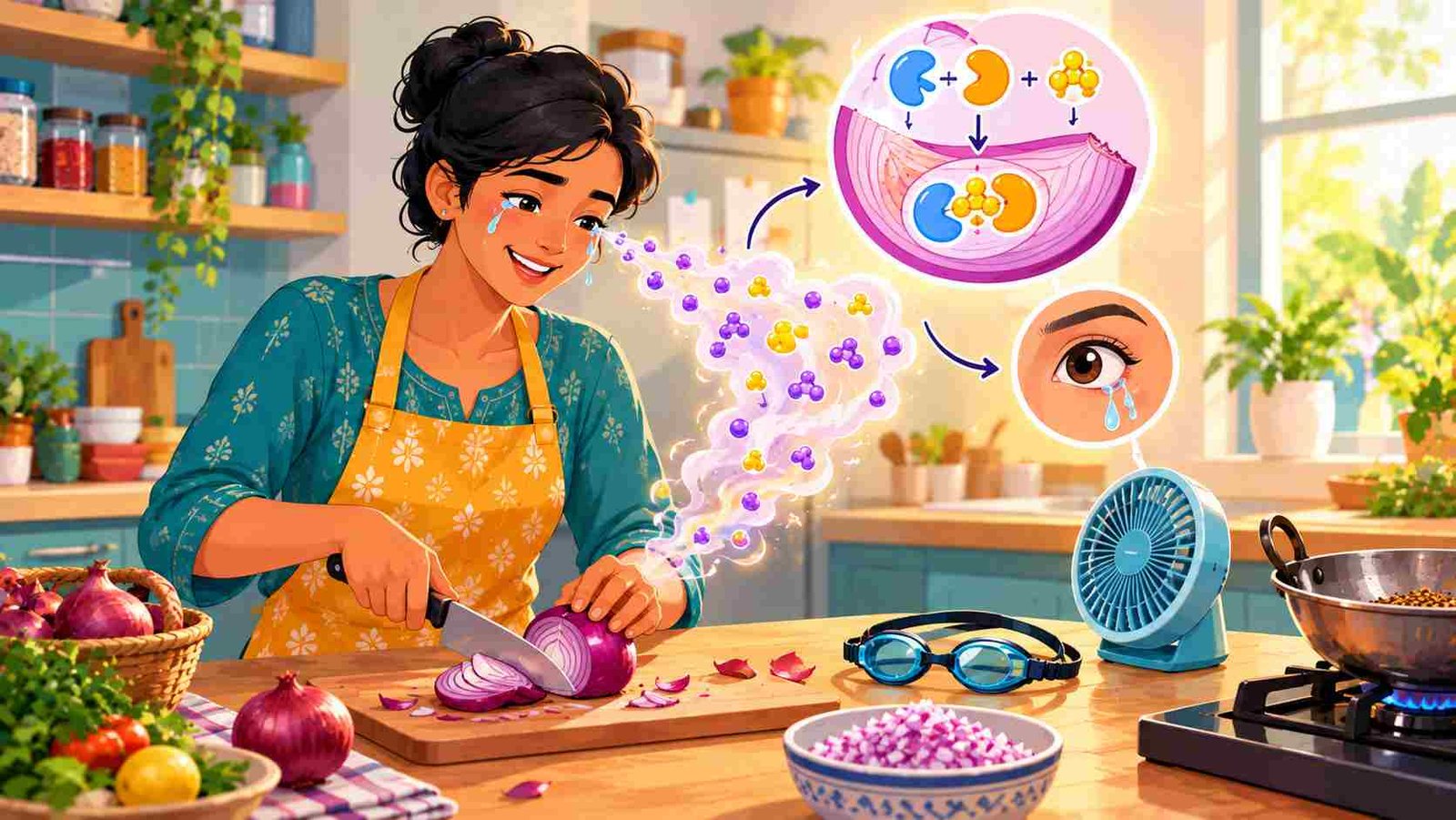
Every Indian kitchen knows the moment. The knife goes through the onion, and within seconds your eyes sting, your nose runs and tears roll down your cheeks. You are not sad about dinner. So **why do onions make you cry**? The answer is a short, clever chain of chemical reactions, and one of the most surprising discoveries in kitchen science.
This guide explains **the chemistry behind why onions make you cry**, how your eyes react, which tricks really help and what makes some onions gentler than others.
## The Quick Answer: Why Onions Make You Cry
Cutting an onion breaks its cells. That lets two substances that were kept apart meet and react, producing a tiny, airy chemical that drifts up to your eyes. Your eyes detect it as an irritant and flood with tears to wash it away.
In short: damaged cells, an enzyme, a sulfur compound and a protective eye reflex.
## What Is the Chemical in Onions That Makes You Cry?
**What is the chemical in onions that makes you cry?** It is a gas called **syn-propanethial-S-oxide**, often shortened to PTSO. It is also called the **onion lachrymatory factor**. "Lachrymatory" simply means "tear-producing."
**What is syn-propanethial-S-oxide?** It is a small, **volatile** sulfur compound, which means it evaporates easily and floats through the air. This makes it effective at reaching your eyes from the cutting board, and some people call it an **onion tear gas compound**, though it is far milder than the real thing.
## The Step-by-Step Chemical Reaction
Here is the **onion chemical reaction**, step by step [VERIFY details against a reliable chemistry source].
### Step 1: The Onion Is Intact
Inside an intact onion, the ingredients for the reaction are stored in separate parts of its cells. Sulfur-containing molecules called **amino acid sulfoxides** sit in the cell's fluid, or cytoplasm. One of them, called **isoalliin**, is the main one responsible for the tears. The enzyme **alliinase** is stored in a separate compartment called the **vacuole** [VERIFY].
This is why an uncut onion hardly smells.
### Step 2: You Cut the Onion
The knife damages **onion cell structure**. The compartments break, and the enzyme meets the sulfur-containing molecules. This is the key moment of **cell damage and enzymes** working together.
### Step 3: Alliinase Converts Isoalliin to Sulfenic Acid
The **alliinase enzyme** quickly converts isoalliin into an unstable substance called **1-propenesulfenic acid**, a type of **sulfenic acid** [VERIFY].
### Step 4: The Second Enzyme Makes the Tear Gas
For years, scientists believed the sulfenic acid simply rearranged by itself into the tear-causing gas. But in 2002, a Japanese research team reported a second enzyme, called **lachrymatory factor synthase**, that speeds up this step [VERIFY: Imai et al., *Nature*, 2002]. The enzyme turns sulfenic acid into syn-propanethial-S-oxide.
The team later received an Ig Nobel Prize for this work [VERIFY year and category; commonly reported as 2013, chemistry]. The Ig Nobel Prizes honour research that first makes people laugh and then makes them think.
### Step 5: The Gas Reaches Your Eyes
The gas floats up from the cut onion by **gas diffusion** and settles on your eyes. There, it dissolves into the thin layer of moisture on the surface, the tear film. Some popular explanations say it forms sulfuric acid in your eye. That version is often repeated, but the actual science is more complicated [VERIFY and avoid over-simplifying]. What matters is that the gas stimulates nerve endings.
### The Short Version in Four Lines
1. Cutting breaks the cells.
2. Alliinase turns isoalliin into sulfenic acid.
3. Lachrymatory factor synthase turns that into the tear gas.
4. The gas reaches your eyes and triggers tears.
## How Your Eyes React: The Biology of Onion Tears
### Sensors on the Cornea
The front of your eye, the cornea, is packed with sensitive **corneal nerves**, which belong to the **trigeminal nerve** system. They act like alarm sensors. Research suggests the onion gas activates a receptor called **TRPA1**, which responds to irritants [VERIFY].
### Reflex Tears vs Emotional Tears
Your brain gets the alarm signal and tells the **lacrimal gland** to produce more tears. These are **reflex tears**, a protective response. Humans make several kinds of tears:
- **Basal tears:** the constant thin layer that keeps your eyes moist
- **Reflex tears:** a flood triggered by irritants like onion gas, smoke or wind
- **Emotional tears:** shed when we feel strong emotions
Reflex tears can differ in make-up from emotional tears, though researchers are still studying this [VERIFY]. Either way, the goal is to wash away the irritant and protect the **tear film**.
### Why Do Onions Make You Cry Instead of Just Smell?
You smell the onion through your nose, but you feel the burning gas on your eyes. The same gas can irritate your nose too, which is why your nose often runs as well.
## Why Do Some People Cry More Than Others?
**Why do I cry more with some onions?** Several things play a role:
- **Onion type.** Some are more pungent than others.
- **Sulfur levels.** **Sulfur in soil** and **sulfur fertiliser** can make onions more pungent [VERIFY].
- **Freshness.** Onions can change in pungency during storage [VERIFY].
- **Your eyes.** People with **sensitive eyes** or **dry eyes** may feel it more, and **allergies** can add to irritation.
- **Distance and air flow.** Standing close with no breeze increases your exposure.
- **Contact lenses.** Some people find lenses help create a barrier, while others find they trap irritants [VERIFY].
**Do men cry less from onions?** There is no firm evidence of a strong difference by sex. Individual differences matter much more.
## Why Don't Cooked Onions Make You Cry?
**Why do cooked onions not make you cry?** Heat damages enzymes. This is called **enzyme denaturation**: the enzymes lose their shape and stop working, so they can no longer produce the tear gas. This is also why the onion in your hot **tadka** doesn't make you cry once it hits the oil. The tears come from the cutting stage, not the cooking.
Acid, such as vinegar or lemon juice, can also slow the enzymes, which is why pickled onions are less irritating [VERIFY].
## Why Don't Garlic and Other Alliums Make You Cry?
**Why do onions make you cry but not garlic?** Garlic belongs to the same plant family, and it also releases sulfur compounds when cut. But its main compound is **allicin**, which has a different chemistry and doesn't produce the same tear-causing gas [VERIFY]. Garlic gives a sharp smell and a burn on the tongue, but rarely tears. Related plants such as **shallots**, **leeks**, **chives**, **spring onions** and **scallions** differ in how much they irritate.
## How to Cut Onions Without Crying: Tips That Work
**How to stop crying when cutting onions?** The tips below follow the chemistry. Their effectiveness varies, and many are based on kitchen experience rather than strong studies [VERIFY for any claim of proven results].
### Slow Down the Reaction
- **Chill onions before cutting.** Cold slows enzymes and reduces how much gas escapes into the air. Refrigerate for 30 minutes, or **freeze onions for 15 minutes** [VERIFY best timing].
- **Cut the root last.** The root end contains more of the sulfur compounds, so leave it intact until the end.
- **Use a sharp knife.** A sharp blade damages fewer cells than a dull one, so less gas is released. **Do sharp knives help?** In theory, yes.
### Keep the Gas Away From Your Eyes
- **Use a fan or exhaust.** Good **kitchen ventilation** carries the gas away. Placing the board **near an exhaust fan** can help.
- **Wear onion goggles.** **Do goggles work for onions?** Tight-fitting **swimming goggles** or special onion goggles are among the most reliable options because they physically block the gas.
- **Cut at arm's length** with your head back, if you can.
### Use Water
- **Peel and cut under running water**, or **cut onions under water**. The gas dissolves in water, so less reaches your eyes. Be careful with slippery knives and boards.
- **Soak onions in water** after cutting, or briefly before, to wash out some compounds. This may reduce pungency but also some flavour.
- Keep a **wet cutting board** to catch some of the gas.
### Other Tricks, With Mixed Evidence
- **Chewing gum** or holding **bread in your mouth** are popular tricks. **Does chewing gum stop onion tears?** The idea is that breathing through your mouth reduces nose exposure, but evidence is thin [VERIFY].
- **A candle near the cutting board** is said to burn off the gas. **Does a candle stop onion tears?** It is a popular tip but not well proven. If you try it, keep flames away from loose clothing, hair and flammable items. Think of it as optional.
- **Microwaving** an onion for a few seconds before cutting may reduce the reaction through heat, though it changes texture [VERIFY].
- Use a **food processor** or **mandoline slicer** to cut quickly and keep your face farther away.
### Wash Up
To **remove onion smell from hands**, rub them on **stainless steel**, such as a spoon or sink, under running water, or use soap and lemon. Whether "stainless steel soap" works scientifically is debated [VERIFY]. **Wash hands after cutting onions**, and avoid touching your eyes. Clean your **cutting board** well too.
## Tearless Onions: Can Science Fix the Problem?
Yes, to a degree. **Which onions are tearless?** There are a few options.
- **Sweet onions**, such as **Vidalia**, tend to be milder and less pungent, partly because they have lower sulfur levels and are grown that way [VERIFY].
- A Japanese company, **House Foods**, developed a **tearless onion** by using **gene silencing** to reduce the enzyme lachrymatory factor synthase [VERIFY details, year and commercial availability]. Without the enzyme, less of the tear gas forms. Research found that the onions also produce different sulfur compounds, changing the flavour [VERIFY].
- **Sunions**, a **sweet onion** brand sold in some markets, is described as tear-light through conventional **onion breeding** [VERIFY].
**Are genetically modified onions** widely sold? Not as far as common information goes, and rules vary by country [VERIFY].
## Onion Varieties and Tears
**Which onion makes you cry the most?** Strongly flavoured varieties tend to release more irritant. These include many **yellow onions**, **red onions** and **white onions**, though pungency varies with growing conditions. **Shallots vs onions tears:** shallots tend to be milder, though they can still sting. **Pearl onions** are small but can still cause tears.
In India, you will meet many types. **Sambar onions**, the small ones, are known for a strong flavour, and the common **pink onion** is a kitchen staple [VERIFY regional names and traits]. **Onion varieties in India** differ in pungency, colour, size and storage life.
## Onions in India: A Little Context
India is one of the world's largest producers of onions, and onions are central to the diet [VERIFY ranking and figures from a named source, such as FAO or the government]. They form the base of countless dishes: **onion masala base**, **onion gravy**, **onion paste**, **onion tadka**, crispy **fried onions** (birista) for biryani, and snacks such as **onion pakora** and **onion bhaji**. Slow-cooked **caramelised onions** add sweetness.
Some communities follow food traditions that avoid onions and garlic, including **Jain food without onion**, and many **no onion no garlic** recipes exist for fasting days and religious occasions.
Maharashtra is a major growing region, and **Lasalgaon**, near **Nashik**, is known as one of Asia's biggest onion markets [VERIFY]. **Onion prices** often make headlines, and price swings and **export** decisions have been political topics in India [VERIFY current situation]. Research bodies such as the **ICAR Directorate of Onion and Garlic Research** work on varieties and storage [VERIFY name and location].
### Storing and Prepping Onions
To **store onions**, keep them in a cool, dry, well-ventilated place away from sunlight. Don't store them with potatoes, as both may spoil faster [VERIFY]. Whole onions can last for weeks or months depending on variety and conditions, while cut onions should be refrigerated and used within a few days [VERIFY food safety guidance].
## Is It Harmful to Cry From Onions?
**Are onion tears harmful?** For most people, no. The irritation is temporary and usually fades within minutes after you leave the area and rinse your face. **How long do onion tears last?** Usually just a few minutes.
A few cautions:
- **Is onion juice bad for eyes?** Direct contact can sting. If juice gets in your eyes, rinse well with clean water.
- If pain, redness or blurry vision continues, see a doctor.
- Some people may be sensitive or **allergic to onions**, with symptoms such as itching, rash or swelling [VERIFY]. A doctor can advise.
## A Fun Kitchen Science Activity
For **science for kids** or **STEM activities**, you can show how the gas works with simple observations:
1. With adult help, cut one chilled onion and one room-temperature onion.
2. Notice which causes more tears.
3. Try cutting a cooked onion and a raw one.
It is a safe, fun way to explore **chemistry in the kitchen**. Always have an adult handle knives.
## Frequently Asked Questions
### 1. Why do onions make you cry?
Cutting an onion releases enzymes that turn sulfur compounds into a gas called syn-propanethial-S-oxide. The gas irritates nerves in your eyes, and your body responds with tears to wash it away.
### 2. How can I cut onions without crying?
Chill the onion, use a sharp knife, cut the root last, ventilate the kitchen, and try tight goggles or cutting under running water. Results vary from person to person.
### 3. Why don't cooked onions make you cry?
Heat destroys the enzymes that create the tear-causing gas, so cooked onions can't produce it.
### 4. Are there onions that don't make you cry?
Sweet varieties tend to cause fewer tears, and some tear-reduced onions have been developed, though availability varies [VERIFY].
### 5. Are onion tears bad for your eyes?
They are harmless for most people and pass quickly. If irritation continues or you notice pain or vision changes, see a doctor.
## Conclusion
Onions make you cry because cutting them sets off a fast chain reaction: broken cells, two enzymes and a tiny drifting gas that your eyes treat as an intruder. Understanding the chemistry also explains the fixes: chill them, cut them sharply, keep the gas away from your face and cook them to switch off the enzymes. Next time the tears come, you will know that it is just good chemistry at work.
Frequently Asked Questions
How do I comment on a Articlesblog article?
Scroll to the Comments section at the bottom of any article, enter your name, email, and message, and click Post Comment. No account is needed, but every comment is moderated — it appears publicly only after the editorial team approves it. See the Privacy Policy for how details are handled.
Why hasn't my comment appeared?
Comments are held for review by default. If yours has not appeared, it is still pending or was rejected during moderation; approved comments appear on the article automatically. If it has been waiting more than a day or two, send a note through the contact page.
How do I share a Articlesblog article?
Every article has a share bar with buttons for Facebook, X, Pinterest, LinkedIn, WhatsApp, Threads, Instagram, TikTok, and YouTube, plus a Copy Link button. Clicking a button opens that network's share window with the article link and title already filled in.
How does Articlesblog pick related articles?
The Related Articles sidebar and the More to Read section show up to four other published articles from the same category, ranked by view count, with popular articles from elsewhere on the site added when the category is new. Tags under each article link to related searches.
Does an article show when it was last updated?
Article pages show the author, publish date, reading time, and view count. A separate last-updated date is not displayed at present, so treat the publish date as the article's currency. Ask the team about a specific article's revision history via the contact page.



Comments (0)
Be the first to comment!
Leave a Comment